
Somewhere in the middle of a wiring project, most people building a standalone setup hit the same fork in the road. The ECU is sorted, the sensor plan is coming together, and now you have to decide how the fuel pump, the fans, the coils, the injectors and everything else actually gets power. There are really three answers now, not two. The old one is a fuse box and a bank of relays. The newer one is a standalone ECU paired with a separate power distribution module, a PDM. And the newest is a single unit that is both ECU and PDM in one box, with the power distribution built into the engine management, so there is no fuse box, no relay bank, and no separate PDM to wire at all.
This article lays all three side by side and tries to be honest about each. None is automatically right: a PDM is clever hardware, but it is not free, it is not simple, and it puts a small computer in the middle of your power system. Which one suits you depends entirely on what you are building.
The three ways to distribute power
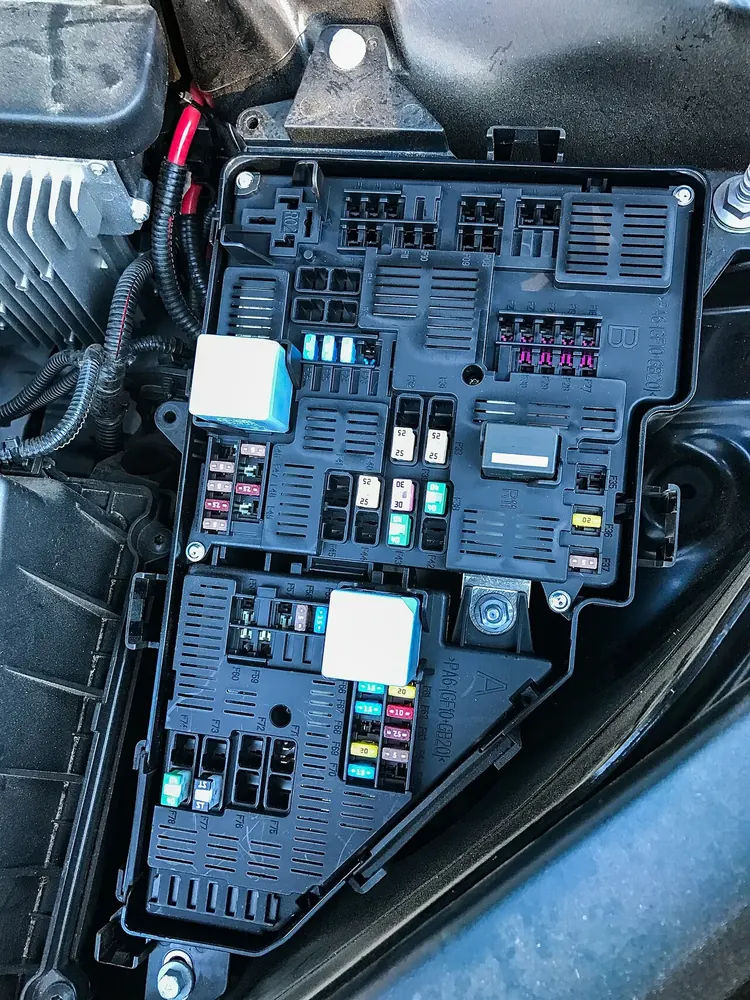
A traditional fuse-and-relay system is how cars have distributed power for decades. Battery voltage comes in, splits across a fuse box, and each circuit is protected by a fuse sized to its wire and load. To switch something high-current, like a fuel pump or fans, the ECU energises a relay: a small electromagnet closes a heavy contact so a thin trigger wire can switch a fat power wire. Fusible links protect the big feeds. It is all mechanical, all analogue, and every part is a cheap, standardised item you can buy at any parts counter.
A standalone ECU plus a separate PDM throws all of that out. (The PDM is also sold as a PMU or power management unit, occasionally a PDU or VCM depending on the brand.) Instead of fuses and relays it uses solid-state switches (power MOSFETs) and protects each output in software with a programmable current limit that acts like a resettable virtual fuse. It talks to the ECU over CAN, measures current and voltage on every channel, and is configured on a laptop. Real examples are the Haltech PD16, the Link Razor PDM, the ECUMaster PMU16 and PMU24, and the MoTeC PDM family. The internals are the subject of how a power distribution module works; here we only care whether you want one.
An integrated PDM-ECU puts both jobs in one box. The engine management and the solid-state power distribution share a board, so the ECU drives its own high-current outputs directly. The clearest examples are the Haltech Nexus R3 and R5, which Haltech calls VCUs (Vehicle Control Units): a full ECU, a power distribution module, a data logger and a wideband controller in one unit. Wire the loads straight to the VCU’s outputs and you are done: no fuse box, no relay bank, no separate PDM, and no CAN link between ECU and power management because they are the same device. The output count is fixed by the unit (a Nexus R5 gives four 25-amp outputs, twelve 8-amp outputs, and eighteen injector plus twelve ignition drivers), but you can still bolt on a PD16 for more channels when you outgrow it.
The StandaloneHQ selector frames these the same way: a separate PDM is an add-on module contributing its own signal-typed outputs, and an integrated unit like the Nexus R5 is the ECU already carrying those outputs, with a PD16 offered as an optional add-on. Either way, the point is how power reaches everything the ECU commands.

Weight and harness complexity
This is where solid-state power management wins most convincingly. A serious fuse-and-relay setup for a modern turbo engine is a nest: a fuse box, five or six relays, all the trigger wiring, the ground returns, and the feeds fanning out from the battery. Every relay is two circuits and every fuse is a junction, and it adds up to a lot of wire, connectors and weight.
A PDM collapses that. With the outputs switched inside the box, the relays and fuse box disappear and most of the trigger wiring goes with them; you feed the box with a couple of heavy cables and run a single wire to each load. On a complex car the weight saving can be several kilos, which alone can justify it on a race build. The integrated PDM-ECU takes this furthest, with no second box and no CAN cable between ECU and power management, just the VCU, its feeds and a wire per load. It is the cleanest harness of the three by a clear margin. On a simple engine the maths flips for both PDM routes: if your whole system is three relays and a handful of fuses, solid-state management does not save enough to matter, and you would be spending real money to delete a fuse box that was never the problem.
Diagnostics
When a fuse blows on a traditional system, you find out the hard way: something stops working, and then you go hunting with a test light, pulling fuses and back-probing connectors. An intermittent fault that only shorts when hot and vibrating can cost you a weekend.
A PDM changes that job. Because it measures current and voltage on every output continuously, it can tell you exactly which channel tripped and how much it was pulling, and log that to your dash or laptop. A fuel pump that is slowly dying shows up as a rising trend on a graph, not a roadside failure. For anyone who logs their car or hates chasing electrical gremlins this is the feature that sells PDMs, and a fuse box can never match it. Paired with the spare I/O and CAN headroom you build in from the start, fault-finding becomes reading a screen rather than crawling under the dash. This applies equally whether the outputs sit in a separate PDM or inside a VCU.
Reconfigurability
On a fuse-and-relay car, changing anything electrical means changing wiring. Add a two-step trigger, re-fuse a circuit, make the fans come on with the AC, soft-start the headlights, and you are back on the crimpers. On any solid-state box, most of that is a software change: re-assign an output, change a virtual-fuse rating, add logic (“run the thermofan 90 seconds after key-off if coolant is above 95 degrees”), or set an output to pulse-width modulate, all without touching a wire. For a build that keeps evolving that is a big deal; for a car wired once and left alone, it is a feature you use twice and forget.
Cost, and the part nobody likes to say
A complete fuse-and-relay solution, even a sealed Bussmann-style module with quality relays, is cheap: a couple of hundred dollars at most. A PDM is not: depending on channel count you are looking at anywhere from a mid-range ECU’s price up to more than the ECU itself for the big motorsport boxes. And the cost does not end at purchase. A PDM must be configured with the same care as tuning: every current limit, retry strategy and logic rule set and tested. That is time and, at a shop, billable time. A fuse box needs none of that.
The integrated route complicates the sums. A VCU is one purchase instead of two, so it can work out cheaper than a top-tier ECU plus a separate PDM wired together. The catch is that you buy a fixed set of power outputs bundled with the ECU whether you use them all or not, and you cannot mix vendors: the power management is whatever that ECU maker built in. Outgrow the channel count and you are adding a PDM anyway, which erases part of the simplicity you paid for.
The single-point-of-failure question
The most common worry about PDMs is legitimate: it is one box, and if it dies a lot of the car dies with it. Two things put it in perspective. First, a fuse-and-relay system is not immune either: relays weld and corrode, fuse boxes crack and let water in, a chafed main feed takes out just as much; the PDM concentrates failure modes more than it adds them. Second, good installs plan for it with a well-protected main feed, independent critical loads, sensible retry logic and a limp-home strategy, all covered in wiring a PDM into a standalone setup. It is manageable, but if not being able to hotwire your fuel pump with a spare relay at the roadside bothers you, listen to that instinct.
This is the one place the integrated unit is arguably worse. When the ECU and the power distribution are the same box, one failure can take out both the engine management and the power to everything at once, where a separate PDM at least fails independently of the ECU. It does not make a VCU a bad choice (plenty of serious cars run them), but it does mean the failover planning matters even more when you are all-in on one device.
So which of the three, and for whom
A traditional fuse-and-relay setup is the right call for a straightforward street swap, a budget build, or an owner who values roadside repairability and standard parts over software and telemetry. There is no shame in a well-built relay panel; done properly it is reliable, cheap, and understood by every auto electrician on earth. Spending power-management money to replace it on a mild build is often the wrong priority when that budget could go into the ECU, the sensors, or the grounding and reference wiring that causes most no-start headaches.
A standalone ECU plus a separate PDM makes sense when the build has a lot of loads, when weight and harness cleanliness matter, when you log the car and want channel-level data, or when the setup keeps changing. The separate-box route also lets you keep an ECU you already own and keep the two failing independently, and with a unit like the Link Razor or ECUMaster PMU you can mix brands. The Haltech PD16 only works with Haltech Elite and Nexus ECUs. Race cars, high-output street builds with a dozen-plus circuits, and anyone burned by an intermittent electrical fault tend to end up here.
An integrated PDM-ECU is the pick when you want the cleanest, fewest-boxes install and are happy to commit to one vendor’s ecosystem. It fits a fresh build with no ECU yet, where one VCU is tidier and often cheaper than an ECU plus a PDM, and anyone who values a single device and single software package over mixing brands. The price is the biggest single-point-of-failure of the three and a fixed output count, so it suits builds that sit comfortably inside what the VCU offers, with a PD16 in reserve.
Solid-state power management is a genuinely better way to distribute power than fuses and relays, and integrating it into the ECU is cleaner still, but “better” and “cleaner” are not the same as “necessary.” Match the tool to the build. Whichever route you pick, the next step is understanding what is inside the hardware and how to plan the channels, which is where the rest of this series goes, and planning the whole harness around any of the three is covered in building a reliable standalone harness.
Not sure which of the three your build needs? The StandaloneHQ guided selector derives the full list of loads and outputs your engine needs, represents integrated units like the Nexus R5 as an ECU already carrying its power outputs, and shows a separate PDM as an add-on module with its own signal-typed outputs, so you can see exactly what each route would replace before you spend the money.
Manufacturer sources checked for this guide: Haltech PD16 product page; Haltech Nexus R5 product page; Haltech Nexus R3 product page; Link Razor PDM; Link Razor CAN setup; ECUMaster PMU-16; MoTeC PDM range.
Always verify against the manufacturer’s manual and your tuner before wiring.